Followers

Tuesday, February 7, 2017

Some Mo[o]re work done


There has been work in a number of areas since the last post.  First, a review of the schematic with the locations:


And now each of the three levels working from the top down.  The numbers locations above correspond to the numbered locations in the plans of the three levels.


Track arrangements at the major locations in the train room were refined.  The drawings below have been oriented to correspond with the plans above:

On entering the room on the left is Piney River on the lower level.  The drawings below show the original plan and the lower drawing the current thoughts on track arrangement.  The inspiration here is American Cyanamid plant that used to be at Piney River, VA, served by the Virginia Blue Ridge.  


Continuing along the aisle to the left and on the upper level is Ozone.  The "Shay branch" takes off here and its inspiration is the Brimstone RR that served both coal and a sawmill with two very pretty Shays.  Based on experience on a layout operated last year, have changed the "Shay branch" to have an initial ~10% grade out of Ozone.  The original Ozone is on the Southern Rwy line in east TN that previously was the Tennessee Central Railroad.  Ozone business has as inspiration the Old Granddads distillery that had the Frankfort and Cincinnati serving it.  The plan on the left is the original idea, the one on the right shows current with the "Shay branch" having the shorter, steeper run but now it is NOT running behind 14 ft of flats.


The upper level of the peninsula had several iterations of Saltville, VA.  Two intermediate ones are below with the upper drawing showing the outline of the lower level extending beyond the back edge of the upper level:


The next two drawing show the original idea on the below the new, and correct to built dimensions, of the upper level.  The track that runs into the 2 ft reach line inspiration is the Olin Mathieson plant in Saltville, VA, that had its own industrial line reached by the N&W.  The simpler track arrangement next to the aisle has as inspiration the plaster plant that was located on the N&W line just outside of Saltville.


The next two drawings are the Morley after an L&N town/location in east TN.  This is the more "free lanced" location.  The lower drawing is the first thought
 and the upper is the current.  There are a number of various manufacturing industries here:


Work was done on the gates at the door where the lower level, nolex and upper level cross the doorway, the lower two with drop leafs and the upper with a raise leaf.  Since there is less brackets at this location to support the added weight and handling of the leafs, I decided to reinforce support of the three levels against the right hand wall.  Three 1 X 4 were put against the sheet rock wall and 2 X 2 blocks were glued and screwed at the proper levels.
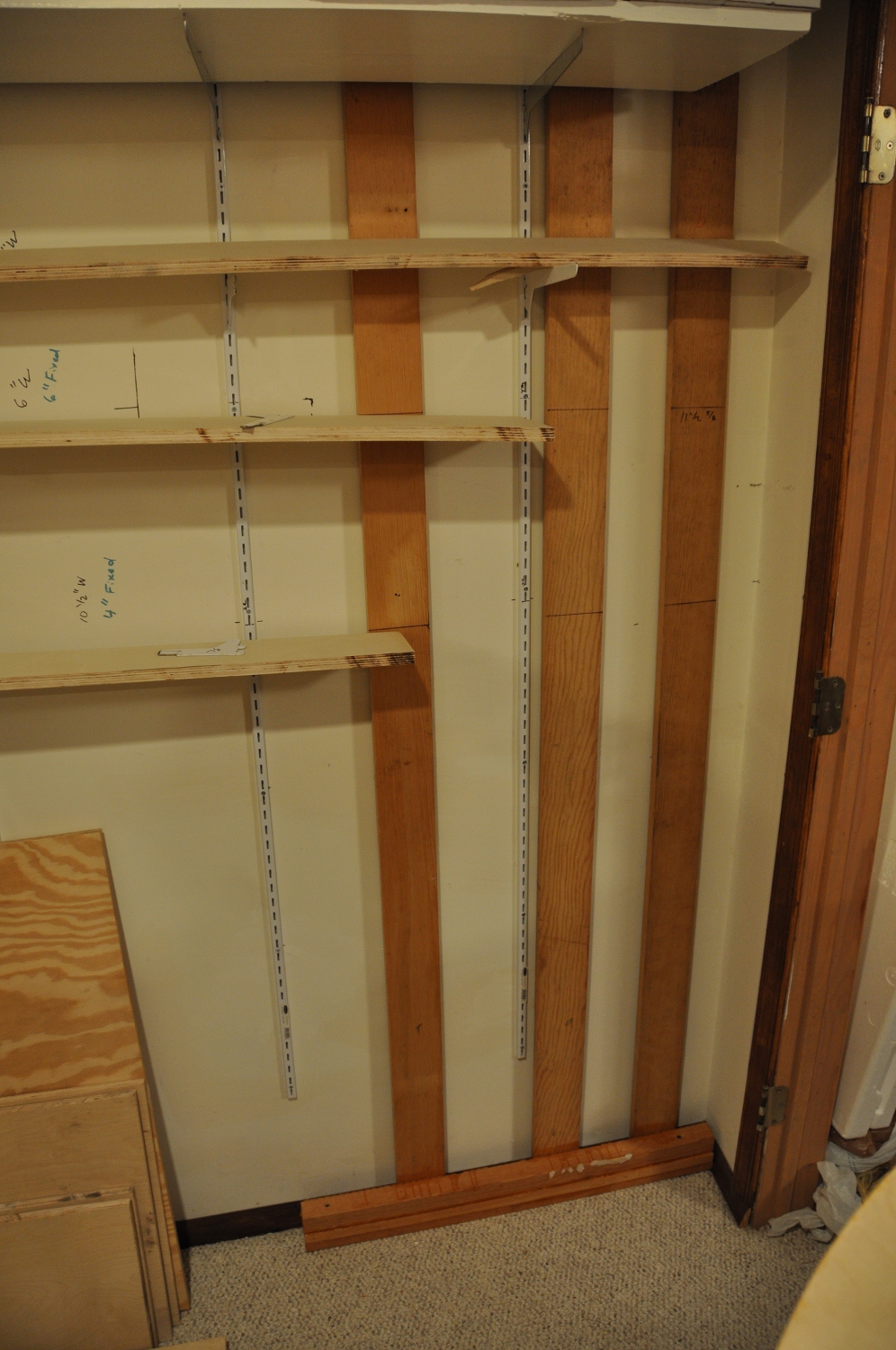
 The various levels of subroadbed were used to draw lines on the supports. The 2 X 2 blocks were clamped to the vertical supports, and level/grade established [the no-lex has both X and Y grade through this area].


Glued and screwed supports:


Hinge added to the wall side of the no-lex:


Sometimes the bracket has to be installed over a screw:


When this occurs it is necessary to grind out the area between the two tabs to clear the screw head and also grind the upper tab a little shorter to clear the threaded portion of the screw.  The modified bracket is on the left.


Reaching some of the brackets and their corresponding risers can be a pain, especially in the corner.  It was necessary to remove the lower level plywood to reach the brackets in the corner for the no-lex.


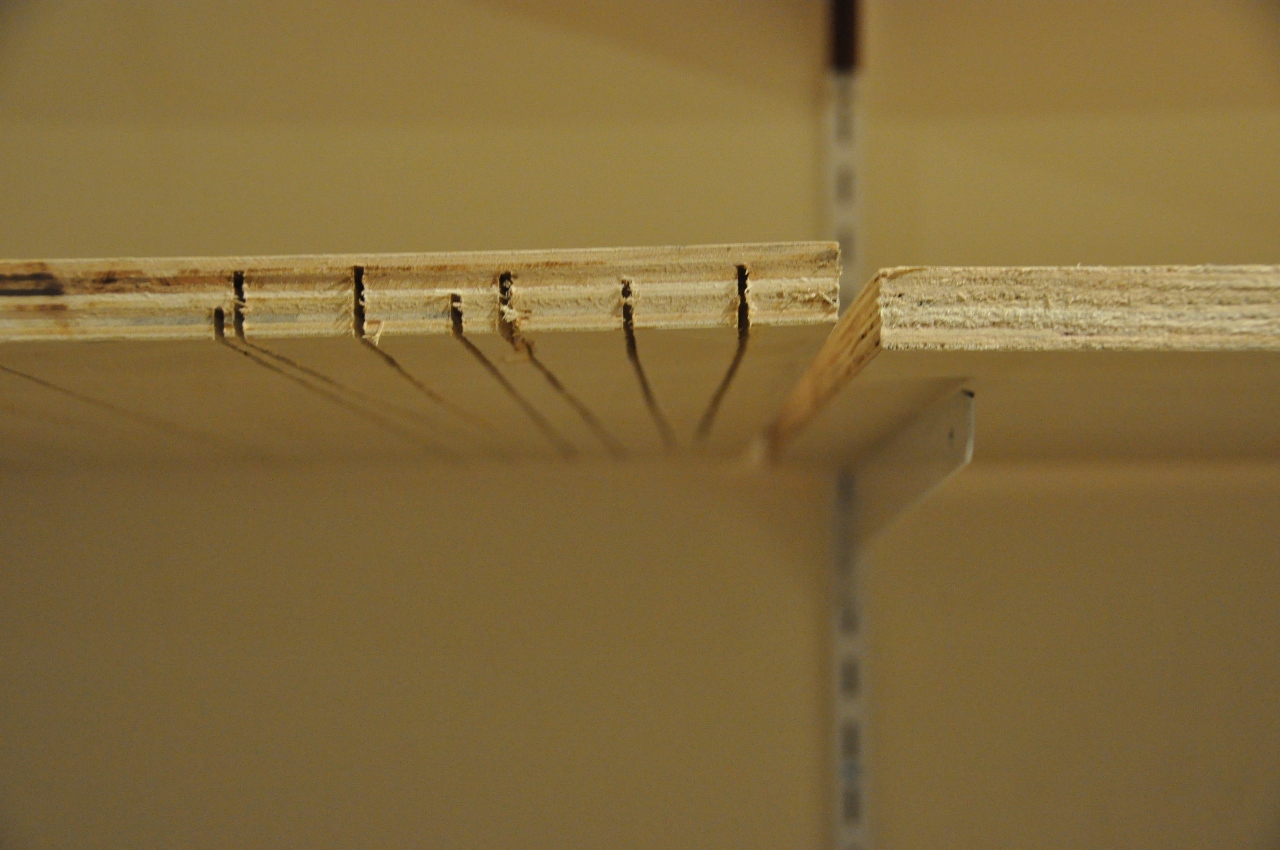
The original solid "cookie cutter" curve for the Shay branch was replaced by plywood that was slotted on the underside to provide flexibility in the X and Y directions as the line curves up.  This first photo is the rigid piece of curved plywood coming down to Ozone on the left.


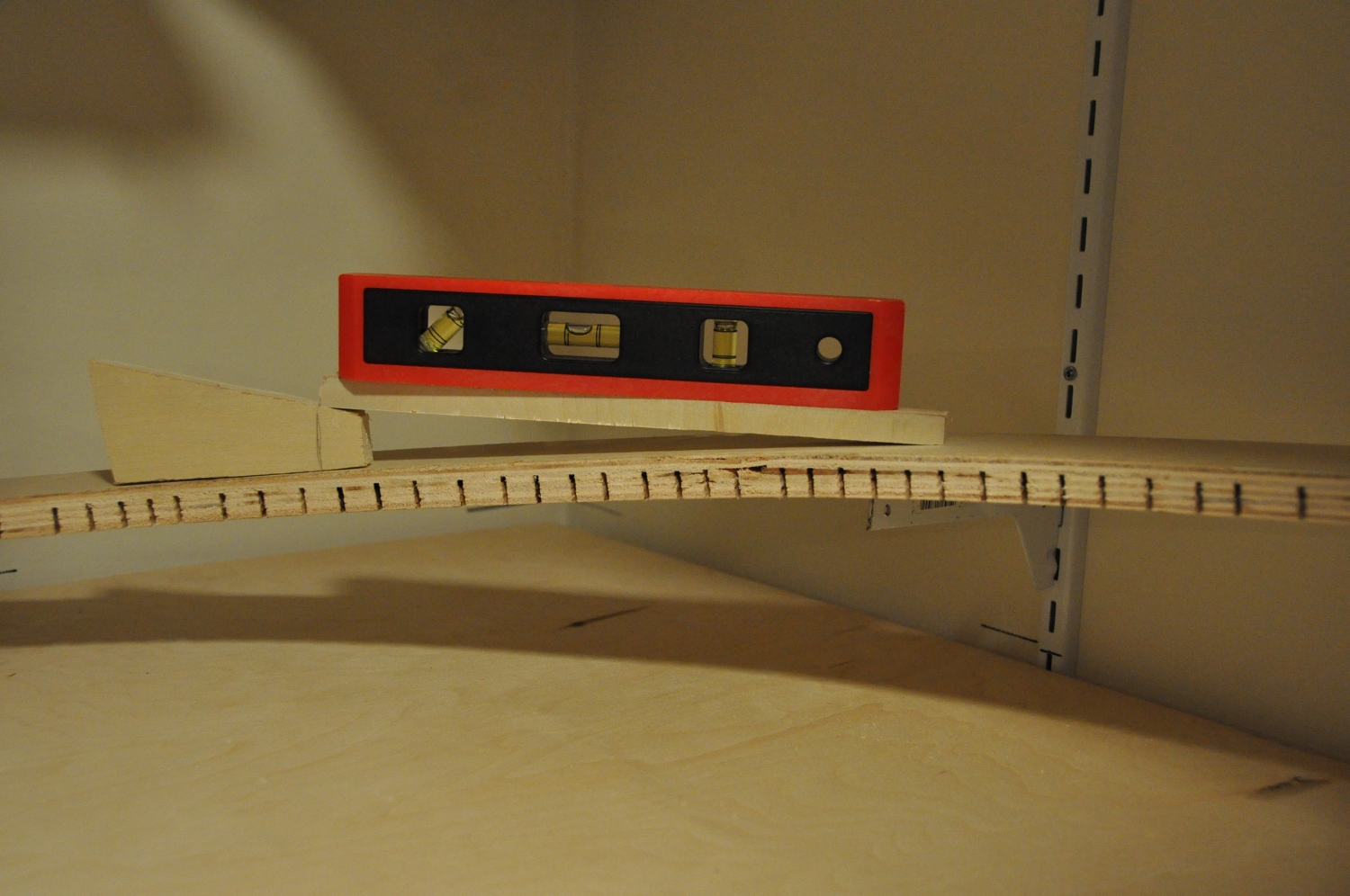
Here is the "10%" "adjustment jig" level check on the slotted plywood that has some flexibility in the X and Y directions:


A stiffener of steel channel was added under the upper level crossing of the window at Ozone like was done for the peninsula under Saltville.  Here the bolts are being cut to length.


Here are the bottom and top views:


Two of the through wall connections were made between the closet and the train room at the upper level.  Quite awkward getting the clamps in place on the back side and dealing with the cork that had been installed on one side and not the other.  Each plate connection was glued and screwed.


Inspiration photo of the Southern tunnel in Alexandria for handling the visual of how the train goes through the wall show on the lower level.  


This through wall connection is from the closet in the hole onto the peninsula on the right.


The passing siding  at Solitude that was at the window on the no-lex under Ozone was moved slightly upgrade for a bridge/trestle in that area and the sub-grade modified with a removable section screwed but NOT glued in place.  Here the 2.8% jig is being used to check the grade.


I tried to get "flat"/unbowed plywood, it has a way of bowing some of the time when cut.  Here is the piece coming upgrade from Ozone.


Most of the no-lex, the upper level and all the Shay branch have had the plates joining the individual sections glued and screwed and a lot of the risers put on place on these areas.  As noted before, getting the clamps in place where the sub-grade is against the wall can be a real task.  Paper used to keep the glue from gluing the clamp to the roadbed. 


  Roadbed after installation of connecting plates.  The first photo is the lower end of the no-lex.


  General views of the train room:

Piney River wall:


Under Ozone looking towards Piney River:


Saltville on the upper level of the peninsula with, in the distance, the inspiration photos resting on the 1.2% no-lex grade under the Shay Branch.


You may have noticed some "inspiration" photos set in place.  Have some for the Brimstone, Saltville and Piney River.  Since the area being modeled is so compressed, the track arrangement cannot be replicated on the model layout.  At one time the Olin Mathieson trackage ran 10 miles distant.

And went ahead and bought some step stools in anticipation of operation:


Wednesday, December 7, 2016

Had the flag out today and in by sunset.  

It's been less than three months since the last post.  Yeah!  Improvement.  

And there has been more "training" - mixture of model operation, photographing and riding the real thing.  But the story here is the V&T Rwy progress.  All work/progress has been in the main train room.  Remember, there is a 2.8% no-lex between the lowest level and the level of the peninsula and a 1.2% grade between the upper peninsula and the next level area before the last 1.2% grade up to the staging in the storage room.  Details of the Shay branch are almost final ant that will be the highest level in the main room.


Some additional cross members were added to the lower level framework for the attachment of terminal blocks.


Then elevation markings were put on the wall for the various levels including the no-lex.  This led to the discovery of the no-lex in the closet entering the train room almost two inches low.  Welllll, that got fixed with the help of Doug.  We also double checked my elevation marking in the train room and re-established some of them.  Two heads are better than one like measure twice, cut once.  We went ahead and installed the piece of no-lex that crossed the window.  

Getting back to work a few days later some brackets got hung on the wall and the basic cut plywood sections laid in place.  


  This was "exploratory" as it was discovered that some pieces identified on the scale sketch actually would better fit elsewhere.  One reason for changes was looking at two dimensional sketches with a 3D model is only an approximation of the real world.  Depth of areas above the lowest level were adjusted to the real world view and doing some actual checks of a person making a reach.


Another reason for changes is some pieces cut from the "flat" 4' X 8' sheets ended up with bow. 


Then the decision to 1] leave as it and hope the joint plate will make it straight, 2] use another piece, 3] cut off the curved portion and put a flat piece in there, or 4] see if cutting some kerfs would allow it to straighten, or at least easier to straighten.  Went ahead and put in the kerfs since if they didn't work that section could cut out removing the offending curve.


I then went back to adding a metal channel to stiffen the no-lex piece across the window [had put aluminum angles on the edges when first installing it].  


Later the width of a portion of this piece was modified  for a section of single track to cross a bridge.  The photos below show how I set in place the risers while maintaining level.

The riser is held in place by hand while pilot holes are drilled.  The plywood above is then glued and screwed to the riser below.


Then wedges are put in to get the grade where it is needed.


Cross level is then adjusted.


And the riser is then screwed to the bracket.


There are three crossing of the doorway and the original thought was to have a lift-out for the lowest level, a drop down or nod under for the middle and highest level.  I have since decided to have hinges for all three.  The two lower levels dropping down, the lowest level tucking in about 2 inches closer to the wall.  The highest level will rise up.  But first was doing a check of the degree of rise as shown in the below photos.


And a check of elevation as marked on the wall


And does it look right?


Notice the curve in the plywood


This photo shows the use of a "standard" shim at one end of the level to check for constant rise along the length of the no-lex.


Various pieces were loosely set in place to look at 1] depth [or width, the distance from the wall to the edge closest to the aisle] considerations 2] the best use of plywood as well as 3] how tight of curve of the track [two dimensional scale drawing tended to be 24" or 27" radii but if we could put in 30" curves would try to see they would "work"].  


As stated earlier, how deep should the various levels be?  There are two depths on the upper level here and a third depth was looked at.


Some places pieces of track was added to see what one level might look like.


And then compared to how that level fit with the other levels.


One corner viewed at two different times.


The second level of the peninsula was added.  First the rounded end was added and a steel channel bolted to the sheet, centrally located on the underside.  Here are two underside views.


Topside of the bolt.


Then the frame was made and attached to the wall.  The end of the frame away from the wall was held up on 2' X 4's with an additional 3/4" piece to make the required height at the far end.  The required height was designed to be short 1/32" to allow for adjustment with wood shims on the legs.  


See the upper level laying on the floor in the aisle on the left.  It has the rounded end added.


The upper level is in place, the two legs at the end opposite the wall have been added and wood shims added to make the upper level LEVEL.  A third leg was added half way between two legs and  the wall and a third leg added under the lower level as "belt and suspenders" to prevent any sag that would make either level from being non-level.


Finally, additional plywood was cut to fill in the gaps in the plywood roadbed and set in place [9 photos below].

From outside the train room looking in.


Inside looking out.  Three views.


Standing at the doorway and looking to where the photos of inside the doorway were taken.


Two photos of the end of the peninsula.  The doorway is to the right and the yard/closet is the doorway on the left.


Notice what appears to be an offset of the two levels.  The upper level will be operated from the aisle on the right and the lower level from the aisle on the left - a "mini-mushroom" design.


The photo below is standing in the doorway of the closet/yard area looking back with the peninsula on the left.


Looking back at the closet/yard doorway from the opposite direction of the photo above.


Now to cut plates that will be glued, clamped, screwed together, then get the risers in place.